How a hip thrust machine loads your hips decides what you pay and the floor you give up. The Rogue Monster bench leads for Monster rack owners, and the Mikolo Hip Thrust Bench is the cheapest way in.
Plate-loaded frames carry the heaviest sets but need a garage corner. Without a Monster rack, the BootySprout band machine and the folding LifePro slip into a bedroom, while a bench still needs your own barbell and plates.
What is the best hip thrust machine?
The best hip thrust machine matches the load you train with and the floor space you have. A lifter limit caps your body weight and a plate capacity caps the load you add, so the table never compares the two.
| # | Machine | Rating | Type | Weight limit |
|---|---|---|---|---|
| 1 | Rogue Monster Hip Thruster Bench Best overall |
4.6 | Rack-mounted bench | Monster rack rating |
| 2 | BootySprout Best band machine |
4.5 | Band machine | 400 lb (181 kg) lifter |
| 3 | Goimu HT01 Best plate-loaded value |
4.4 | Plate-loaded | 800 lb (363 kg) plates |
| 4 | LifePro GluteBlast Best foldable machine |
4.2 | Foldable bodyweight | 220 lb (100 kg) lifter |
| 5 | Mikolo Hip Thrust Bench Best budget pick |
4.1 | Bench | 700 lb (318 kg) lifter and bar |
| 6 | GMWD HRTQ Best adjustable footboard |
4.0 | Plate-loaded | 800 lb (363 kg) plates |
| 7 | Nautilus Glute Drive Best premium pick |
3.9 | Plate-loaded | 360 lb (163 kg) plates |
The 7 best hip thrust machines (November 2026)
1 - Rogue Monster Hip Thruster Bench (Best Overall)

Pros and Cons
Pros
- Two detent pins come in the box, so mounting needs no extra hardware
- UHMW plastic keeps the steel from scratching the rack uprights
- Vinyl pad wipes clean after a sweaty set
- Stays mounted between sessions, so there is no bench to drag out of storage
Cons
- At 36 lb (16 kg) it takes a firm two-handed grip to carry once it is off the rack
Who is it for?
Who is it for?
- Monster rack owners who already have a barbell and plates
- Lifters who hip thrust heavy several times a week
Who is it not for?
- Lifters with another rack brand or no rack at all
The Rogue Monster Hip Thruster Bench leads my list for lifters who already own a Rogue Monster rack, because it mounts to the uprights and turns that rack into a hip thrust station. It fits Rogue Monster racks only, not other brands.
In my barbell thrusts it felt stable and comfortable, and it arrived fully assembled and ready to mount. Lining up the two detent pins was the only fiddly step before my first set.
Its 11-gauge steel tube and rack-protecting UHMW plastic earn the top durability and quality scores of anything I ranked, which makes sense for a bench that lives on a rack through years of heavy sets.
Specs
| Type | Rack-mounted bench |
|---|---|
| Material | 11-gauge steel tube with vinyl-covered pad |
| Weight limit | Set by the Monster rack it mounts on |
| Footprint | 50.2 x 8.5 in (128 x 22 cm) |
2 - BootySprout (Best Band Machine)
Pros and Cons
Pros
- Needs no plates, so there is nothing to load or store
- Three bands in the box cover light and heavy sets
- NBR foam backrest cushions the upper back through each rep
Cons
- Band tension caps the load below what plates allow
Who is it for?
Who is it for?
- Lifters moving from bodyweight bridges to loaded thrusts
- Bedroom lifters who cannot leave a frame set up
Who is it not for?
- Lifters who already own a stack of heavy plates
The BootySprout asks nothing of a home lifter beyond floor space, which makes it my first pick without a Monster rack. It sat on my bedroom floor with no rack and no spotter.
In my sessions the bands felt light at the bottom of each rep and pulled hardest at lockout, where the glutes work most. Swapping bands between sets cost time, so I used one band per exercise.
It costs less than any plate-loaded frame here and matches the Goimu HT01 on effectiveness. For a small home gym, its low price and matching effectiveness score decide the ranking.
Specs
| Type | Band-resisted machine |
|---|---|
| Material | Alloy steel with NBR foam backrest |
| Weight limit | 400 lb (181 kg), lifter weight |
| Footprint | 29 x 25 x 7 in (74 x 64 x 18 cm) |
3 - Goimu HT01 (Best Plate-loaded Value)
Pros and Cons
Pros
- Grip handles with a safety limiter let you stop a heavy set cleanly
- A weight holder keeps loaded plates on the frame
- Band pegs let you add stretch tension on top of the plates
Cons
- Loading plates on both sides takes effort between sets
Who is it for?
Who is it for?
- Lifters who have outgrown bands and now own heavy plates
- Lifters who already clip bands onto their rack
Who is it not for?
- Lifters short on floor space
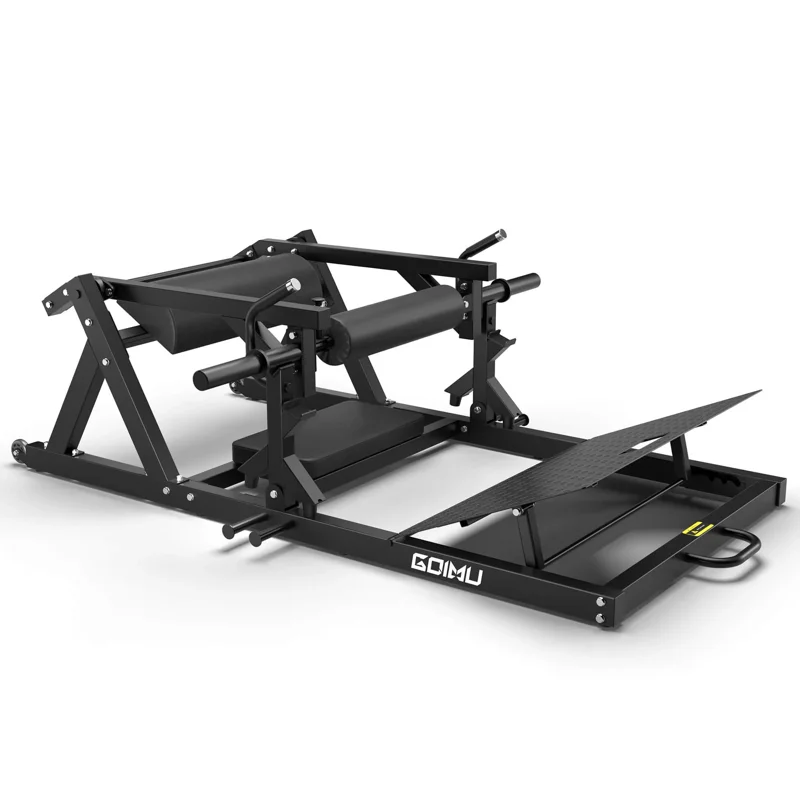
I put the Goimu HT01 third because it gives garage lifters a full plate-loaded thrust for the price of plates and a spare corner of floor.
The long frame ate most of my garage floor, though the hip pad stayed comfortable against my hip bones under a loaded set. The band pegs let me stack stretch on top of the plates.
It costs a third less than the GMWD HRTQ and gives up the adjustable footboard and the smaller footprint to get there.
Specs
| Type | Plate-loaded machine |
|---|---|
| Material | Alloy steel with foam pads |
| Weight limit | 800 lb (363 kg), plate capacity |
| Footprint | 80.8 x 53.9 x 24 in (205 x 137 x 61 cm) |
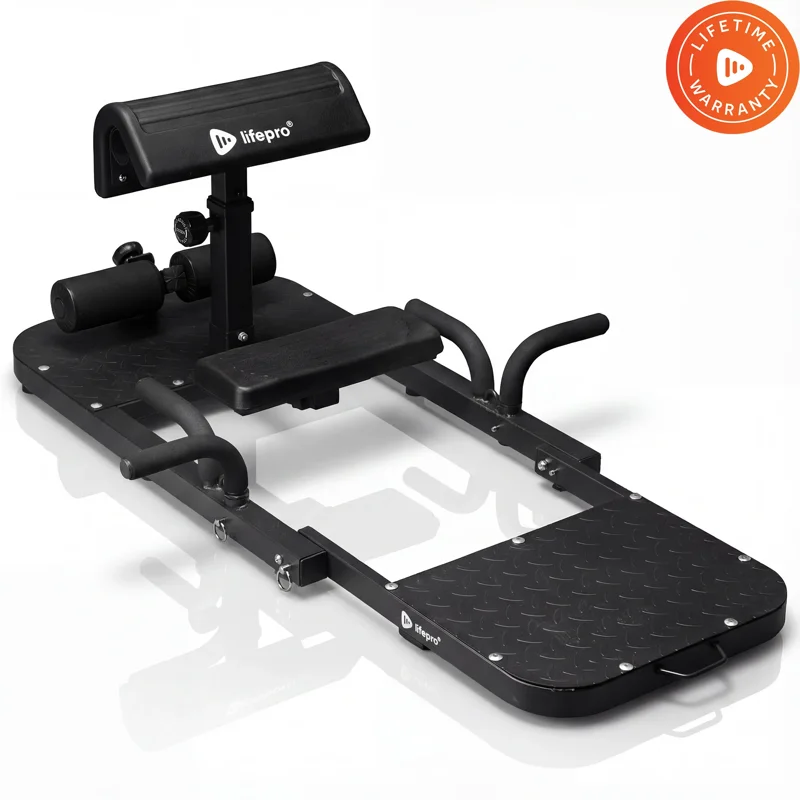
4 - LifePro GluteBlast (Best Foldable Machine)
Pros and Cons
Pros
- Adjustable handles suit different body sizes
- Wheels and a flat fold make it easy to stash
- Doubles as a sissy squat station for leg day
Cons
- The low lifter limit rules out heavier lifters entirely
Who is it for?
Who is it for?
- Apartment dwellers who store gear after each session
- Lighter lifters adding sissy squats to leg day
Who is it not for?
- Lifters above its body weight limit
Folding flat and rolling away on built-in wheels, the LifePro GluteBlast vanishes behind a door once the session ends.
It crept on a smooth floor when I drove up hard, so I slid a mat under it. The PU leather pad held my back well, and the frame doubled as a sissy squat station.
Every rep is a bodyweight thrust, and the limit counts the lifter's own weight, so check your weight against the specs before ordering a machine that folds this small.
Specs
| Type | Foldable bodyweight machine |
|---|---|
| Material | Powder-coated steel with PU leather pad |
| Weight limit | 220 lb (100 kg), lifter weight |
| Footprint | 45.3 x 27.2 x 21.3 in (115 x 69 x 54 cm) open, 39 x 27.2 x 18.9 in (99 x 69 x 48 cm) folded |
5 - Mikolo Hip Thrust Bench (Best Budget Pick)
Pros and Cons
Pros
- Carries in one hand, so it moves between rooms with ease
- Low price leaves money for plates
- Also works for glute bridges and push-ups
Cons
- Rolling a loaded bar into place takes two hands and a clear floor
Who is it for?
Who is it for?
- Garage lifters whose barbell and plates are already paid for
- Shoppers keeping the total spend low
Who is it not for?
- Lifters who load a heavy barbell at home with no spotter
I would only buy the Mikolo Hip Thrust Bench for a garage that already holds a barbell and plates, and then it is cheapest.
Using it, I loaded the bar myself and rolled it over my hips every set, so a barbell pad was a must. The anti-slip pads kept the bench planted, and the dense foam held its shape under the bar.
Nothing here holds the load for you, so a heavy bar wants a spotter or a roll into place each set. Budget for a barbell pad too, since the bar presses into the hip bones.
Specs
| Type | Bench for barbell hip thrusts |
|---|---|
| Material | Leather over high-density foam |
| Weight limit | 700 lb (318 kg), lifter and bar |
| Footprint | 15.7 x 17.5 x 13.8 in (40 x 44 x 35 cm) |
6 - GMWD HRTQ (Best Adjustable Footboard)
Pros and Cons
Pros
- Full-length back pad supports the spine through the lift
- Weight holder takes both standard and Olympic plates
- Dual pivot bearings keep the motion smooth
Cons
- The long frame leaves little room to walk around it
Who is it for?
Who is it for?
- Heavy lifters who need a footboard that fits their leg length
- Training partners of different heights sharing one machine
Who is it not for?
- Lifters whose spare floor runs shorter than 6 ft (183 cm)
Footboard slots set the GMWD HRTQ apart, because the board moves to three positions and lets tall and short lifters share one machine.
The frame stretches long and needed a clear run of floor, but I tried each slot until my shins stood upright at lockout and the full-length back pad stayed put all the way up.
It costs half as much again as the Goimu HT01 and has no band pegs. The footboard and the smaller footprint are what justify the gap.
Specs
| Type | Plate-loaded machine |
|---|---|
| Material | 14-gauge steel with padded back pad |
| Weight limit | 800 lb (363 kg), plate capacity |
| Footprint | 71 x 31 x 22 in (180 x 79 x 56 cm) |
7 - Nautilus Glute Drive (Best Premium Pick)

Pros and Cons
Pros
- Belt keeps the hips from shifting under a heavy load
- Plate loading lets you raise the load in small steps
- Steel frame stays planted through a loaded set
Cons
- Claims a 62 x 60 in (157 x 152 cm) patch of floor for good
- Loading plates on each side takes time between sets
Who is it for?
Who is it for?
- Buyers who prefer a brand-name machine
- Home gym owners with spare plates and floor space
Who is it not for?
- Apartment lifters who share a floor with neighbors
The Nautilus Glute Drive comes from a fitness brand and targets buyers who want a permanent plate-loaded machine in a home gym.
I started with a light load and built up one plate at a time, which is how I would introduce anyone to a machine this size. The padded belt sat comfortably across my hips.
Plates are sold separately, and the third-party price runs about seven times that of the next dearest machine here, which is why it ranks last.
Specs
| Type | Plate-loaded machine |
|---|---|
| Material | Alloy steel frame |
| Weight limit | 360 lb (163 kg), plate capacity |
| Footprint | 62 x 60 x 35 in (157 x 152 x 89 cm) |
How did I choose these hip thrust machines?
I bought each machine, set it up at home and ran hip thrusts on it. I looked at how it loads the hips, how steady the frame stays and how much floor it needs.
Durability reflects how the hip pad and frame held up under a loaded bar or band. Quality reflects pad comfort and how steady the frame stayed, and effectiveness reflects how much glute work each machine let me do.
Price and user ratings come from the store each machine links to, so the cheapest machine earns the top price score. I dropped any machine with no current offer.
How do you choose a hip thrust machine?
You choose a hip thrust machine by weighing load type, weight limit, floor space and comfort. Start with load type, because it settles most of what the other three look like.
1. Which type of hip thrust machine fits your training?
The type of hip thrust machine that fits your training depends on how you want to load the lift. Plate-loaded machines hold barbell plates, band machines use stretch resistance and benches leave the loading to you.
A rack-mounted bench such as the Rogue Monster needs the matching rack, while a loose bench like the Mikolo works anywhere you can roll a barbell into place.
2. How much weight capacity do you need?
You need a weight limit that fits your plans, and you need to know what that number measures. Six of the seven machines state a limit, and they state three different things.
A lifter limit is the body weight the frame carries, as on the BootySprout at 400 lb (181 kg) and the LifePro at 220 lb (100 kg). A plate capacity is the load you can add, as on the Goimu, the GMWD and the Nautilus.
The Mikolo bench states a limit for the lifter and the bar together. Compare a lifter limit with your body weight and a plate capacity with the heaviest plates you will load.
The Rogue Monster bench states no limit of its own, so the rating of the Monster rack that carries it sets the ceiling.
3. How much floor space does a hip thrust machine need?
A hip thrust machine needs floor space equal to its footprint plus room to sit down and stand up around it. Plate-loaded frames take the most floor, and the Goimu HT01 has the biggest footprint of the seven.
The gap runs from the 15.7 x 17.5 in (40 x 44 cm) Mikolo bench to the 80.8 x 53.9 in (205 x 137 cm) Goimu. The Rogue bench takes only 50.2 x 8.5 in (128 x 22 cm) but needs its rack. Measure your space and leave clearance for loading plates.
4. What makes a hip thrust machine comfortable?
A hip thrust machine is comfortable when the pad spreads pressure away from the hip bones and the back support stays put. A thick hip pad and a stable back pad do most of that work.
The Goimu hip pad stayed comfortable under a loaded set and the GMWD full-length back pad stayed put. The LifePro PU leather pad held my back, and the Mikolo bench needs a barbell pad on top.
How do you use a hip thrust machine?
You use a hip thrust machine by setting the footboard and back pad so your knees bend to a right angle at the top of the lift. Sit with your upper back against the pad and your feet flat.
Brace your core, drive through your heels and lift your hips until your hips and knees extend fully. Pause at the top, then lower under control.
Start with bodyweight or the lightest band, and add load only when your form stays clean on every rep.
Is a hip thrust machine better than a barbell?
A hip thrust machine is better than a barbell when you want a repeatable setup. The machine fixes the path and pads the hips, so you skip rolling and padding a bar before every set.
A barbell and bench cost less when you already own the plates, and they carry whatever load your plates allow. A machine earns its price through setup speed and safety stops.
FAQs
What is the best hip thrust machine for home?
The best hip thrust machine for home is the one whose footprint fits your room, and the LifePro GluteBlast folds down to 39 x 27.2 in (99 x 69 cm). The GMWD HRTQ runs 71 in (180 cm) long and wants a spare room or a garage.
What muscles does a hip thrust machine work?
A hip thrust machine works the gluteus maximus most, along with the hamstrings, adductors and quads. The spinal erectors and core stay braced to hold your torso steady through each rep.
How many times a week should you hip thrust?
You should hip thrust two or three times a week in most programs, with a rest day between sessions so the glutes recover and grow.
Can a hip thrust machine damage your floor?
A hip thrust machine can dent or scuff a floor under a heavy load, so set it on a rubber mat. The mat also keeps the frame from sliding as you drive up.
My Verdict on the Best Hip Thrust Machine
I pick the Rogue Monster Hip Thruster Bench for anyone who already owns a Monster rack, because it felt stable and comfortable under my barbell and its 11-gauge steel tube holds a loaded bar.
Without that rack, I would buy the BootySprout for a bedroom or the Goimu HT01 for heavy plates. If your garage already holds a barbell and plates, the Mikolo Hip Thrust Bench keeps the bill lowest.
Our #1 Recommendation
Rogue Monster Hip Thruster Bench (Best Overall)
Rated With Total Shape's Scoring System

- Two detent pins come in the box, so mounting needs no extra hardware
- UHMW plastic keeps the steel from scratching the rack uprights
- Vinyl pad wipes clean after a sweaty set
- Stays mounted between sessions, so there is no bench to drag out of storage
- Get the BEST PRICE until the end of November
- At 36 lb (16 kg) it takes a firm two-handed grip to carry once it is off the rack
About The Author


You May Also Like