38
Considered
 62
of Research
 89
Examined
 9
Interviewed

A cable crossover earns its floor space only when the stack weight, pulley ratio and footprint fit your room. The Body-Solid Powerline PFT100 leads on rating, and the Mikolo Wall Mount Cable Station is the cheapest way into cable training.
Prices run from a few hundred dollars for wall units to several thousand for freestanding frames. I assembled or mounted each one and ranked them on how they pull, how loud they are and how much room they need.
What are the best cable crossover machines for a home gym?
The best cable crossover machines for a home gym start with the Body-Solid Powerline PFT100, and the Weight and Setup columns show the limits that decide fit.
| # | Machine | Rating | Weight | Setup |
|---|---|---|---|---|
| 1 | Body-Solid Powerline PFT100 Best overall |
4.7 | 2 x 160 lb stacks | Freestanding |
| 2 | Inspire Fitness FTX Best compact trainer |
4.6 | 2 x 165 lb stacks | Freestanding |
| 3 | XMark Functional Trainer Best commercial-style build |
4.5 | 2 x 200 lb stacks | Freestanding |
| 4 | REP Ares 2.0 Best for rack owners |
4.4 | 2 x 260 lb stacks | Rack attachment |
| 5 | Mikolo Wall Mount Cable Station Best budget pick |
4.3 | 300 lb plate capacity | Wall mount |
| 6 | GOIMU WM2-V4 Best wall mount with a stack |
4.2 | 155 lb stack plus plates | Wall mount |
| 7 | Valor Fitness BD62 Best compact wall unit |
4.0 | 200 lb plate capacity | Wall mount |
| 8 | Body-Solid GDCC250B Best for shared gyms |
3.9 | 2 x 160 lb stacks | Freestanding |
| 9 | Titan Functional Trainer Best numbered pulley heights |
3.8 | 2 x 200 lb stacks | Freestanding |
The 9 best cable crossover machines for home gyms (November 2026)
1 - Body-Solid Powerline PFT100 (Best Overall)

Pros and Cons
Pros
- High and low cables follow the path of a fly or a row
- The 83 in (211 cm) frame clears a standard 96 in (244 cm) ceiling
- Room between the pulleys lets you step in and out of a fly without ducking
- Both stacks come included, so there are no plates to buy
Cons
- At 62.6 in (159 cm) wide it needs a wider bay than the Inspire Fitness FTX at 54 in (137 cm)
Who is it for?
Who is it for?
- Garage lifters with a free wall of at least 63 in (160 cm)
- Home lifters moving up from a single-stack machine to two independent stacks
Who is it not for?
- Lifters with less than 63 in (160 cm) of free wall
The Body-Solid Powerline PFT100 brings the two-arm layout of a commercial crossover into a home gym, with high and low pulleys on one frame and a separate stack for each arm.
Each arm works against its own stack, so a weaker side never borrows help from the stronger one. Moving the pulley height took a pull on the pin and a slide, and it locked in within seconds each time I tried it.
Flys, presses, rows and pulldowns all ran from one frame without swapping parts, which kept a full session in one spot. Assembly went better with a second pair of hands, because the upright columns are heavy to hold while the bolts go in.
Specs
| Resistance | Two 160 lb (73 kg) weight stacks |
|---|---|
| Pulley ratio | 2-to-1, so a 160 lb (73 kg) stack feels like 80 lb (36 kg) |
| Footprint | 42.3 in (107 cm) deep x 62.6 in (159 cm) wide |
| Height | 83 in (211 cm) |
| Setup | Freestanding |
2 - Inspire Fitness FTX (Best Compact Trainer)

Pros and Cons
Pros
- The included rope, curl bar and handles cover curls, pushdowns and rows with nothing extra to buy
- A storage rack keeps handles off the floor between sets
- A shelf holds a phone or tablet during workouts
Cons
- Each stack feels like only 82.5 lb (37 kg) at the handle, so strong lifters outgrow the machine
Who is it for?
Who is it for?
- Two-car households with one bay to spare
- Lifters with a bay only 54 in (137 cm) wide and a ceiling above 82 in (208 cm)
Who is it not for?
- Lifters who need heavier stacks than the stock weight
Inspire Fitness FTX adds a built-in pull-up bar to a dual-stack frame, so back and shoulder work needs no separate rack or doorway bar.
The sliding pulleys moved smoothly from low cable work to high, and the included rope, curl bar and handles covered curls, pushdowns and rows. A pin change clunked loudly in my quiet garage.
It takes the least floor of the freestanding stack machines here. The pulley guides needed a firm tug to seat after I moved them between exercises.
Specs
| Resistance | Two 165 lb (75 kg) weight stacks |
|---|---|
| Pulley ratio | 2-to-1, so each pulley feels like 82.5 lb (37 kg) |
| Footprint | 40 in (102 cm) deep x 54 in (137 cm) wide |
| Height | 82 in (208 cm) |
| Setup | Freestanding |
3 - XMark Functional Trainer (Best Commercial-style Build)

Pros and Cons
Pros
- Each stack works alone, so one arm or one leg can train at a time
- Nineteen pulley heights run from near the floor to above head height
- The pro attachment set handles curls, rows and pressdowns
Cons
- The wide frame leaves little spare room in a one-car garage
Who is it for?
Who is it for?
- Garage owners with a 65 in (165 cm) wide bay and a ceiling above 83 in (211 cm)
- Training partners of different strength who each need a separate stack
Who is it not for?
- Basement lifters with a ceiling under 83 in (211 cm)
Strong lifters get more load from the XMark Functional Trainer than from the Inspire, and a single pin changes the weight between sets or drop sets with no plates to reload.
The pulleys reach from near the floor to above head height, so presses and pulldowns kept their full range. The cable ran smoothly in my sessions, though the pin clacked on every change.
The wide frame took more floor than I expected. It shipped by freight, so I cleared a path to the room before delivery day.
Specs
| Resistance | Two 200 lb (91 kg) weight stacks |
|---|---|
| Pulley ratio | 2-to-1, so a 200 lb (91 kg) stack feels like 100 lb (45 kg) |
| Footprint | 43.5 in (110 cm) deep x 65 in (165 cm) wide |
| Height | 83 in (211 cm) |
| Setup | Freestanding |
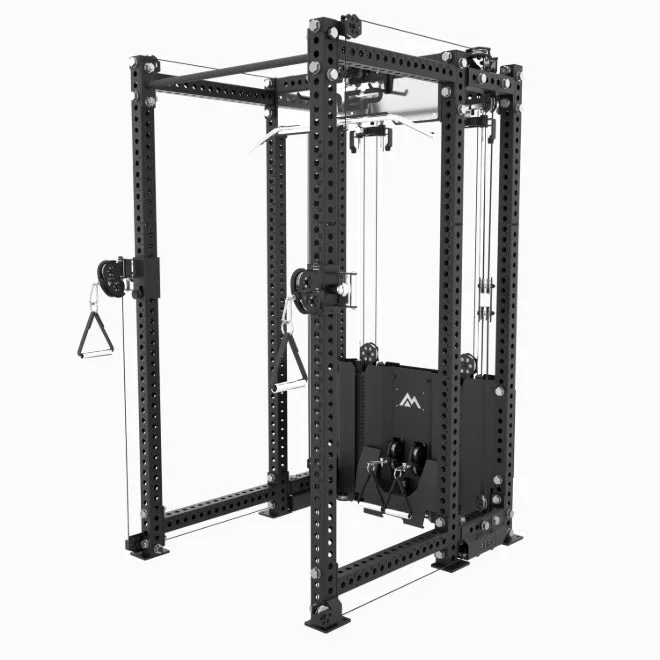
4 - REP Ares 2.0 (Best for Rack Owners)
Pros and Cons
Pros
- Cables run inside the rack, so barbell and cable work share one footprint
- Two people can train on the front trolleys at once
- Stacks can move up to a heavier size later
Cons
- Only the PR-4000 and PR-5000 racks accept it
Who is it for?
Who is it for?
- Owners of a PR-4000 or PR-5000 rack who train with a partner
- Rack owners with no room left for a freestanding frame
Who is it not for?
- Lifters who prefer a freestanding frame
The REP Ares 2.0 turns a compatible REP rack into a cable crossover, so barbell and cable work share one footprint.
Its dual stacks are the heaviest on this list, and each feels like about half its weight at the handle. The trolleys glided smoothly along the uprights in my sessions, and the same unit handled lat pulldowns and low rows.
It adds only a few inches of depth to the rack. It fits REP racks alone, and the freight delivery needed a helper at the door.
Specs
| Resistance | Two 260 lb (118 kg) weight stacks, upgradeable to 310 lb (141 kg) |
|---|---|
| Pulley ratio | 2-to-1, so a 260 lb (118 kg) stack feels like 130 lb (59 kg) |
| Footprint | 57.6 in (146 cm) wide, adds 6 in (15 cm) of depth to the rack |
| Height | 82.1 in (209 cm), or 93.9 in (239 cm) on tall uprights |
| Setup | Rack attachment |
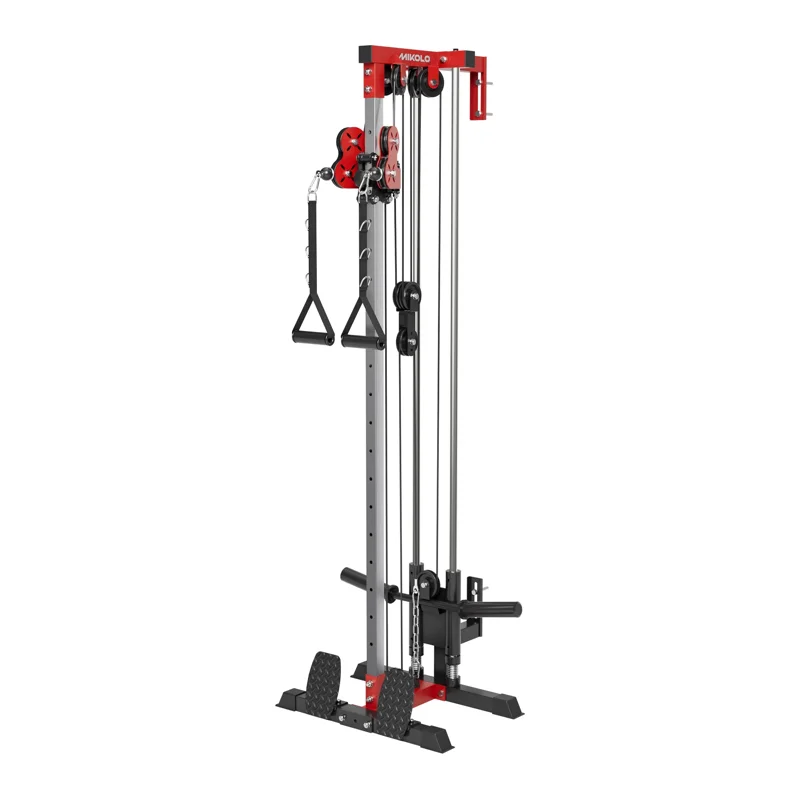
5 - Mikolo Wall Mount Cable Station (Best Budget Pick)
Pros and Cons
Pros
- The H-shaped base keeps the unit steady under load
- A rotating pulley bracket widens the pull path
- The lat bar and rope cover pulldowns, pushdowns and rows with nothing extra to buy
Cons
- Plates are extra, so the real cost climbs if you own none
Who is it for?
Who is it for?
- Home lifters with spare plates and a bare stud wall
- Beginners testing cable work before spending more
Who is it not for?
- Lifters who want weight changes with one pin
One bare stud wall holds the whole Mikolo Wall Mount Cable Station, with dual pulleys at nineteen heights, so the rest of the floor stays open.
A large footboard supports seated rows, and angled pegs stopped plates sliding off during heavy rows. The cable rattled at the pulleys on fast reps, which I heard across the garage.
Every weight change meant sliding plates on and off the pegs, which slowed my drop sets. I kept a few light plates within reach of the footboard to speed that up.
Specs
| Resistance | Plate-loaded, 300 lb (136 kg) plate capacity |
|---|---|
| Pulley ratio | 2-to-1 by default, 1-to-1 with the bracket |
| Footprint | 26.9 in (68 cm) deep x 25.6 in (65 cm) wide |
| Height | 82 in (208 cm) |
| Setup | Wall mount |
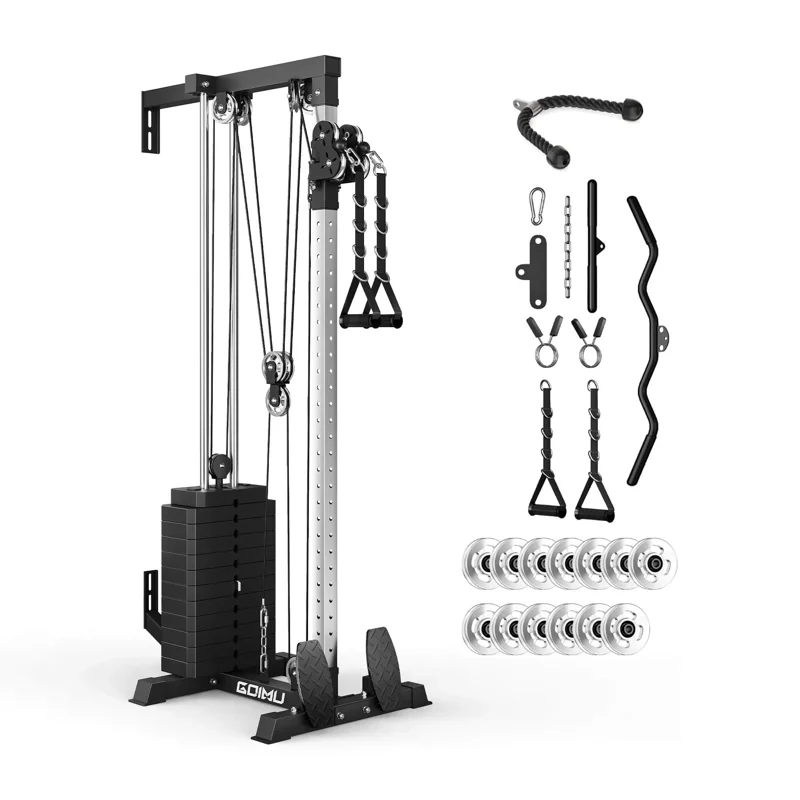
6 - GOIMU WM2-V4 (Best Wall Mount with A Stack)
Pros and Cons
Pros
- Mounts on one stud wall and still gives you a stack
- The switchable ratio gives both light and heavy settings
- Many pulley heights cover low curls and overhead pulls
Cons
- The 155 lb (70 kg) stack feels like half that at the handle in the 2-to-1 setting
Who is it for?
Who is it for?
- Apartment lifters who want pin-loaded weights on a wall
- Lifters who like drop sets and light isolation work
Who is it not for?
- Anyone who needs a stack beyond 155 lb (70 kg)
Wall units rarely carry a weight stack, but the GOIMU WM2-V4 does, and a plate pin adds a heavier option for big sets.
The aluminum pulleys spun freely in my sessions, and the cable tracked straight at every height I tried, even with the handle pulled hard across my chest.
The stack clunked loudly against its guide at every pin change during my sets. I rank it sixth because the stack and ratio switch cost more than plate loading alone.
Specs
| Resistance | 155 lb (70 kg) stack plus a plate pin |
|---|---|
| Pulley ratio | Switchable between 2-to-1 and 1-to-1 |
| Footprint | 33.07 in (84 cm) deep x 23.78 in (60 cm) wide |
| Height | 79.13 in (201 cm) |
| Setup | Wall mount |
7 - Valor Fitness BD62 (Best Compact Wall Unit)

Pros and Cons
Pros
- The included mounting hardware saves a trip to the hardware store
- Dual pulleys cover both low curls and high pulldowns from one wall
- Standard 1 in (2.5 cm) plates fit without an adapter
Cons
- Its 200 lb (91 kg) plate capacity is lower than the Mikolo's 300 lb (136 kg)
Who is it for?
Who is it for?
- Renters who can mount a unit on one stud wall
- Lifters with spare plates and a wall bay only 25 in (64 cm) deep
Who is it not for?
- Anyone who prefers a weight stack
The Valor Fitness BD62 is the most compact wall unit here, with dual pulleys at sixteen heights on a square patch of wall.
In my experience it stays small and still runs curls, rows and pulldowns without a swap of parts. Plates load directly at about one to one, and the mounting hardware in the box went straight into my wall studs.
Its durability and build scores sit below the other wall units, because it loads plates only and its plate limit is the lowest. Olympic plates need an adapter that costs extra.
Specs
| Resistance | Plate-loaded, 200 lb (91 kg) plate capacity |
|---|---|
| Pulley ratio | About 1-to-1, so plates feel their full weight |
| Footprint | 25 in (64 cm) deep x 25 in (64 cm) wide |
| Height | 80 in (203 cm) |
| Setup | Wall mount |
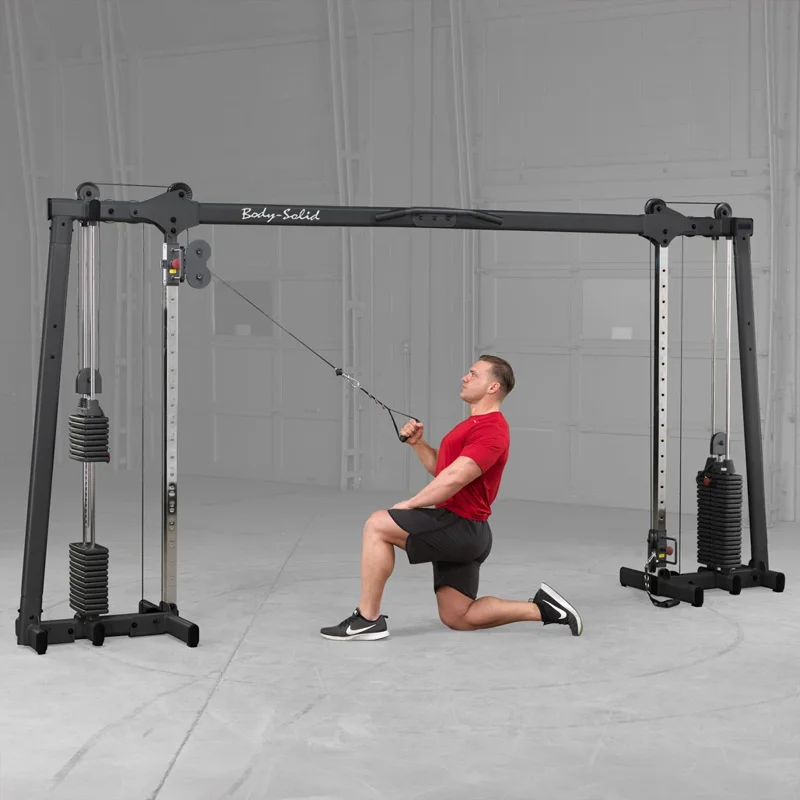
8 - Body-Solid GDCC250B (Best for Shared Gyms)
Pros and Cons
Pros
- Thick oval steel tubing resists flex on heavy pulls
- Lifetime coverage on the frame and welds means no repair bill if a weld fails
- Weight plates and guide rods carry the same coverage, so the moving parts are covered too
Cons
- The frame is wide and deep, so it needs more room than most home gyms offer
Who is it for?
Who is it for?
- Shared-garage lifters with a 73 in (185 cm) wide bay
- Lifters who plan to keep one machine for many years
Who is it not for?
- Beginners who only want to test cable work
The Body-Solid GDCC250B carries a light-commercial rating, so a family or a small team sharing one garage gym can use it every day without wearing it out.
Its dual stacks work independently for true one-arm moves, and the wide main frame gave each arm room to swing through a full crossover fly, even with a second lifter standing close.
It dominated my garage in a way no other machine here did, so I would buy it only when several people use it every week.
Specs
| Resistance | Two 160 lb (73 kg) weight stacks |
|---|---|
| Pulley ratio | 2-to-1, so a 160 lb (73 kg) stack feels like 80 lb (36 kg) |
| Footprint | 43 in (109 cm) deep x 73 in (185 cm) wide |
| Height | 84 in (213 cm) |
| Setup | Freestanding |
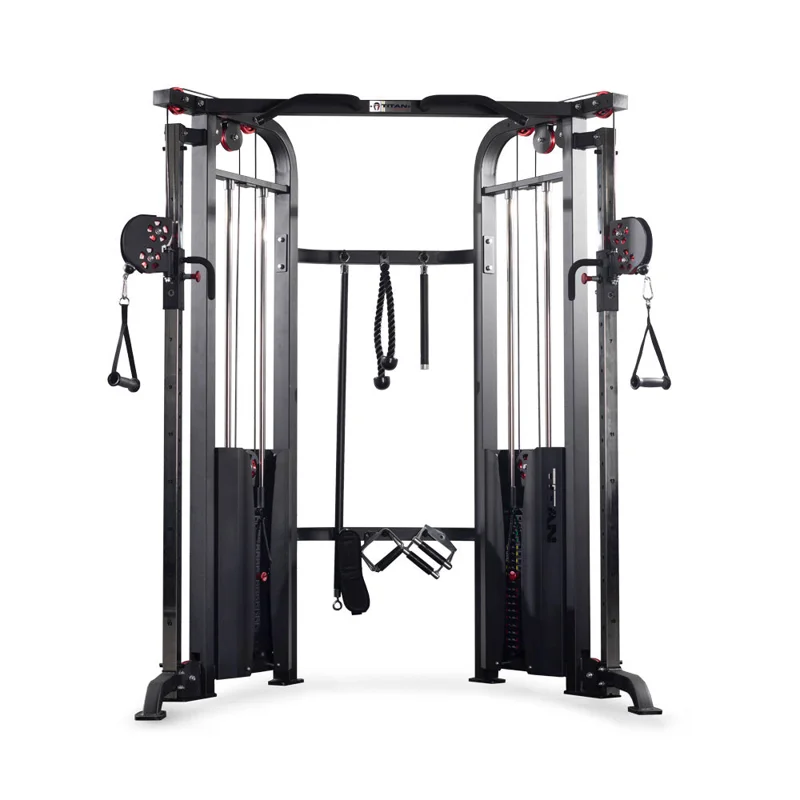
9 - Titan Functional Trainer (Best Numbered Pulley Heights)
Pros and Cons
Pros
- Numbered pulley heights make a setup easy to repeat
- Built-in pull-up handles add a back exercise
- A wide base steadies heavy pulls
Cons
- Assembly takes two people to hold the heavy columns
- At 672 lb (305 kg) its frame outweighs the Inspire and Body-Solid machines
Who is it for?
Who is it for?
- Garage lifters who repeat the same pulley setups every week
- Garage buyers with a 64 in (163 cm) wide bay and an 82 in (208 cm) ceiling
Who is it not for?
- Lifters who want the lowest total cost
The Titan Functional Trainer ships with an accessory set that covers curls, pushdowns and rows, so I needed nothing else before my first workout.
Twenty numbered pulley heights let one frame handle leg and overhead work, and the numbers made my setups easy to repeat. Built-in pull-up handles added a back exercise.
The pin change echoed through my garage every set, and the column bolts took patience to line up. I rank it last because its price sits above every freestanding rival in this group.
Specs
| Resistance | Two 200 lb (91 kg) weight stacks in 10 lb (4.5 kg) steps |
|---|---|
| Pulley ratio | 2-to-1, so a 200 lb (91 kg) stack feels like 100 lb (45 kg) |
| Footprint | 44 in (112 cm) deep x 64 in (163 cm) wide |
| Height | 82 in (208 cm) |
| Setup | Freestanding |
How did I choose these cable crossover machines?
I assembled or mounted each cable crossover machine in my garage and ran flys, pulldowns, rows and curls on it. I noted how the cable felt, how loud the pin or plates were, how hard assembly was and how much floor and wall each unit took.
My hands-on work sets the durability, quality and effectiveness scores. Price and the owner star score on the store each machine links to set the other two, and the cheapest unit takes the top price score.
How do you choose a cable crossover machine?
You choose a cable crossover machine by checking four things in order, which are the resistance type, the pulley ratio, the space and the mount.
1. Should you pick a weight stack or plate loading?
You should pick a weight stack when you want quick changes and plate loading when you want a low price and already own plates.
A stack changes weight with one pin and keeps the plates off the floor between sets. Plate-loaded units such as the Mikolo and Valor cost far less but need a rack of plates and a short pause to reload during drop sets.
2. What does the pulley ratio do?
The pulley ratio sets how heavy the handle feels compared with the stack and how far the cable travels. A 2-to-1 ratio halves the weight at the handle and doubles the cable travel, so a 200 lb (91 kg) stack feels like 100 lb (45 kg).
Most freestanding machines here run 2-to-1, which suits light isolation work. A 1-to-1 setting, as on the GOIMU and the Mikolo bracket, passes the full weight to your hand for heavy presses.
3. How much space does a cable crossover machine need?
A cable crossover machine needs as much space as its frame covers plus room to stand and pull, and a ceiling taller than the frame.
Measure the ceiling first. Every machine here stands between 79 and 94 in (201 and 239 cm) tall, so a standard 96 in (244 cm) ceiling clears all of them.
4. Is a wall mount enough for crossover work?
A wall mount is enough for crossover work when the room is small and a bare stud wall can carry the load.
Wall units that load plates save floor space too. The Mikolo takes up to 300 lb (136 kg) of plates and the Valor up to 200 lb (91 kg), so match that limit to the heaviest weight you lift.
Is a cable crossover machine worth it for a home gym?
A cable crossover machine is worth it for a home gym when you would otherwise need separate machines for flys, rows, pulldowns and curls.
A cable crossover pays off only if you use the cables most weeks. Count your cable sessions over a month on a plate-loaded unit before you pay for a stack.
FAQs
Are cable crossovers effective?
Cable crossovers are effective because the cable keeps tension on the muscle through the whole movement, including the top of a fly where a dumbbell goes slack.
What muscles does a cable crossover machine work?
A cable crossover machine works the chest, shoulders, back, arms and core, and the pulley height decides which of those muscles takes the load.
Do you need help to assemble a cable crossover machine?
You need help to assemble a cable crossover machine when it is a stack machine, because the heavy columns and stacks need a second person to hold them while the bolts go in.
Wall units are lighter, so one person can mount them, but a stud finder and a helper to hold the frame make the job faster.
My Verdict on the Best Cable Crossover Machines
For a home gym with a 63 in (160 cm) free wall I pick the Body-Solid Powerline PFT100, because it carries the top rating on this list.
When the garage is tight I recommend the Inspire Fitness FTX. Rack owners should add the REP Ares 2.0, and anyone on a small budget should start with the Mikolo Wall Mount Cable Station.
Our #1 Recommendation
Body-Solid Powerline PFT100 (Best Overall)
Rated With Total Shape's Scoring System

- High and low cables follow the path of a fly or a row
- The 83 in (211 cm) frame clears a standard 96 in (244 cm) ceiling
- Room between the pulleys lets you step in and out of a fly without ducking
- Both stacks come included, so there are no plates to buy
- At 62.6 in (159 cm) wide it needs a wider bay than the Inspire Fitness FTX at 54 in (137 cm)
About The Author



You May Also Like